


For the past two years, Artificial Intelligence has dominated every headline. But while we were staring at algorithms, we stopped looking at the cash register.
References:
- McKinsey Global Institute. (2024). The next big arenas of competition.
- McKinsey Global Institute. (2025). Capturing the next big arenas of competition in ten charts.
McKinsey’s latest report, “The next big arenas of competition,” settles the debate with hard data. While AI is transformative, the true king of the global economy through 2040 isn’t a chatbot, it’s E-commerce. If you are obsessed with AI while neglecting your sales channel, you are optimizing the engine of a car that has no wheels.
Actionable Takeaways
- The Real Data: E-commerce projects revenues of up to $20 trillion, nearly 5 times that of AI software.
- The Infinite Stair Philosophy: Our mission is born from the 3 ingredients that create these monopolies (Infinite Market, Scaled Investment, Model Shift).
- The Strategy: AI is the tool (the “how”), but E-commerce is the business (the “what”).
Welcome to “The Strategic Oracle” series. This is where we separate the signal from the noise.
1. The Elephant in the Room: AI vs. Reality
If you open LinkedIn today, 90% of the conversations are about AI. And rightfully so: as I wrote in my article on the AI Hype, this technology is redefining how we work. But there is a critical difference between “transforming work” and “generating the world’s revenue.”
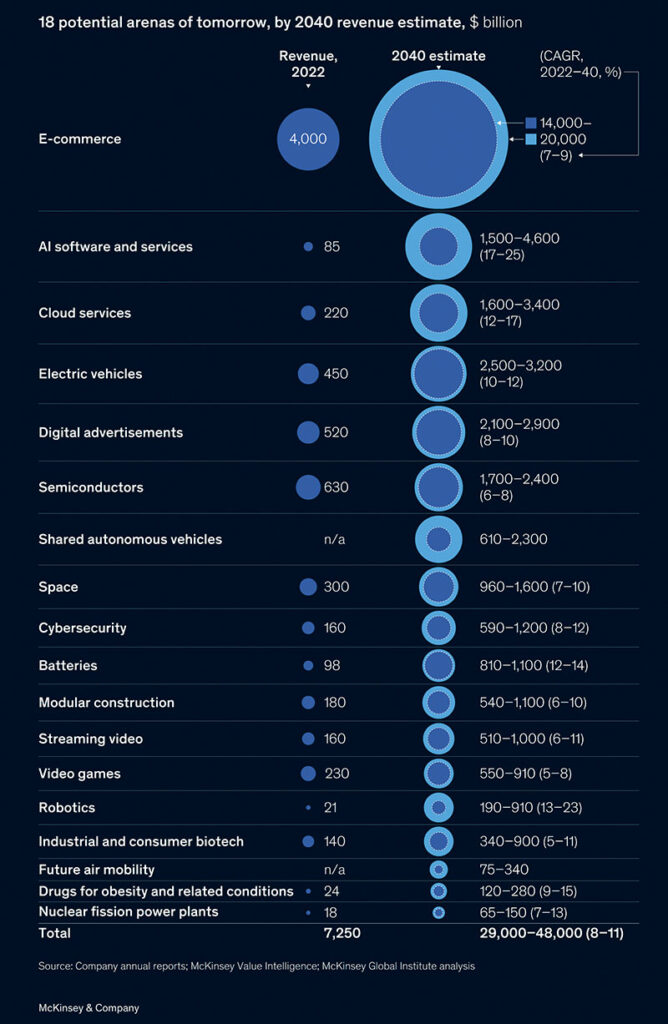
McKinsey has mapped the 18 “Arenas” that will dominate the economy by 2040. When you put the numbers on the table, the hierarchy changes drastically:
- AI Software & Services: Projected $1.5 to $4.6 Trillion.
- E-commerce: Projected $14 to $20 Trillion.
We are talking about an industry that is four times larger than AI in its most optimistic scenario.
2. The DNA of Infinite Stair: A Prophecy Fulfilled
When we founded this agency, we didn’t choose the name Infinite Stair by chance, but by conviction. McKinsey identifies a “potion” of three ingredients that create these global monopolies, and they are literally our DNA:
“Infinite” (Infinite Market)
McKinsey calls this “Large Addressable Market.” You need to operate in sectors without a visible ceiling, touching every aspect of daily human consumption.
“Stair” (Escalatory Investment)
McKinsey calls this “Escalatory Investments.” It is the never-ending stair; the ability to constantly reinvest in technology and logistics to separate winners from the rest.
The Shift (Business Model Step Change)
This is the secret ingredient. McKinsey explains that Arenas are born from a “Business Model Step Change.” It’s not doing the same thing faster; it’s changing how value is delivered.
This is why our mission at Infinite Stair is to help companies make the transitions to these new business models. We aren’t a “maintenance” agency; we are architects of that transition. We help companies make the leap from the traditional model to the Arena model.
3. Shiny Object Syndrome
The strategic danger of 2025 is distraction. The report classifies AI as a “Spin-off Arena” (derived from software), while E-commerce is a massive “Continuing Arena” that towers over all others, surpassing even Cloud Services ($3.4T) and Electric Vehicles ($3.2T) combined.
The lesson is brutal: AI is a critical enabler, yes. But E-commerce is the field where the game is played.
4. Your Roadmap: “The Strategic Oracle” Series
So, how do we execute this model transition without getting lost in the noise?
We have designed this series to give you back your strategic focus:
- Where to Grow: Why LATAM is the mandatory engine many ignore while looking at Silicon Valley.
- How to Compete: The “David Strategy” to use the giants’ infrastructure without being crushed.
- What to Sell: The $4 Trillion Grocery Opportunity, the sleeping giant of e-commerce.
Stop looking only at the tool (AI) and start looking at the building you are constructing (E-commerce).