
WooCommerce Agency · Design, Development & Store Improvements
WooCommerce development built around how your customers buy.
We help DTC brands and retailers build, redesign, and improve WooCommerce stores.
Connect the buying experience with the themes, extensions, and systems your team needs to run the business.
Start with the part of your store that needs to work better.
Improve an existing store
Customers struggle to find products, understand options, or complete a purchase. Identify the friction before deciding what to change.
Redesign with a clear purpose
Your theme or extensions no longer support the experience you need. Define what to keep, adapt, or replace.
Add commerce to WordPress
Turn an existing content site into a shopping experience with a clear catalog, buying journey, and operating setup.
WooCommerce development services for your storefront and operations.
Store design and development
Create or improve navigation, product pages, cart, and checkout around customer needs.
Theme and extension customization
Adapt your setup where existing features fall short, with attention to compatibility and ongoing maintenance.
Product discovery and catalog structure
Help customers find and compare products through categories, filters, and useful product information.
Commerce integrations
Connect agreed product, customer, and order data with CRM, fulfillment, and other business systems.
Performance and maintenance
Investigate bottlenecks and plan updates, compatibility checks, and operational follow-up.
Why WordPress + WooCommerce?
WordPress combines a powerful content management system with the flexibility to build an ecommerce experience around your business. WooCommerce adds commerce capabilities while preserving control over your website, code, data, and infrastructure.
Advanced SEO capabilities
Create custom content structures, optimize technical SEO, control URL architecture, implement structured data, and build landing pages around specific search intents. WordPress offers extensive flexibility for sophisticated SEO strategies beyond the constraints of a predefined platform structure.
Content-driven commerce
Bring buying guides, product comparisons, articles, educational resources, and product catalogs together in one ecosystem. Connect the content that attracts customers with the products they want to buy.
Ownership and control
Access your website's code and data, choose your hosting provider, and decide how your ecommerce experience evolves as your business grows.
An ecommerce platform that adapts to your business.
Your business may need more than a standard product catalog and checkout. WooCommerce lets you customize how customers discover products, compare options, place orders, and interact with your brand.
Custom shopping experiences
Build tailored product pages, configurators, checkout flows, and purchasing journeys around your customers' needs.
Custom checkout experiences
Build checkout flows around your business requirements, including customer-specific fields, approval processes, specialized payment methods, shipping rules, and B2B purchasing workflows. WooCommerce provides extensive access to checkout logic and development.
More flexibility for regulated industries
Businesses in regulated sectors often face restrictions from ecommerce platforms, payment processors, and sales channels. WooCommerce offers greater control over infrastructure, integrations, and payment-provider selection for legally permitted businesses, including those in CBD and hemp, healthcare and medical products, tobacco, adult products, and specialized financial services. All implementations remain subject to applicable laws, hosting policies, and payment-provider approval.
Complex commercial models and integrations
Support B2B purchasing, customer-specific pricing, subscriptions, product bundles, and specialized ordering processes through appropriate extensions and custom development. Connect your store with ERP, CRM, inventory, fulfillment, and other operational systems.
Room to evolve
Add capabilities and adapt processes as your business changes.
Custom checkout and commerce for businesses with specialized requirements.
A standardized checkout is not the right fit for every business. WooCommerce gives developers extensive access to checkout logic, payment integrations, and hosting choices, making it possible to evaluate specialized purchasing flows.
Customize customer-specific fields, approval steps, B2B purchasing, shipping rules, and payment flows. For local or proprietary payment services, WooCommerce supports extensions and custom gateway development when the provider offers suitable APIs and commercial access.
Regulated businesses may face different restrictions from the ecommerce platform, checkout, payment processor, hosting provider, and sales channels. These are separate decisions: a Shopify Payments restriction is not automatically a prohibition on operating a Shopify store, and policies for Shop, Shopify Catalog, and international services must be evaluated independently.
For legally permitted CBD and hemp, tobacco, healthcare and medical products, adult products, and specialized financial services, WooCommerce may offer greater implementation flexibility. That does not mean every product, payment provider, or checkout integration is allowed. Legal requirements, provider approval, infrastructure policies, and security obligations still apply.
We assess platform policies, merchant eligibility, checkout requirements, and available providers before proposing an implementation.
Payment methods and financing across markets.
Examples of payment providers, networks, wallets, and financing options across the United States and Latin America. These logos do not imply native integration, universal availability, or a commercial partnership.






















Local payment methods. Custom payment integrations.
Offer customers the payment options they know and trust. WooCommerce gives businesses the flexibility to connect compatible gateways, digital wallets, bank transfers, regional payment networks, and financing providers.
When a ready-made integration isn't available, we can assess the provider's APIs and build a custom solution. Availability depends on the provider, market, merchant eligibility, and applicable requirements.
Navigation, product pages, and checkout that explain themselves.
We look at how customers move from category to product to cart, and where the experience makes the next step harder.

Premium managed hosting for demanding WooCommerce stores.
When your ecommerce operation requires specialized infrastructure, Kinsta and WP Engine offer premium managed WordPress hosting with performance tools, security features, backups, staging environments, and specialized support.
We evaluate your traffic, catalog, integrations, and technical requirements to determine whether premium hosting is the right investment.
The goal is to reduce infrastructure management while preserving the flexibility and control of WooCommerce.
 Kinsta
 WP Engine








Security and reliability for your WooCommerce store.
Your ecommerce store handles customer information, orders, payments, and business-critical operations. Protecting that environment requires more than installing a security plugin.
Infrastructure protection
Configure appropriate hosting security, SSL, access controls, backups, and protection against common threats.
Controlled updates
Plan WordPress, WooCommerce, theme, and extension updates with compatibility checks and testing to reduce operational risks.
Monitoring and recovery
Establish monitoring, backup, and recovery procedures appropriate to your store's requirements.
Secure integrations
Review permissions, authentication, and data flows when connecting payment services, CRM, ERP, and other systems.
Make your WooCommerce setup easier to understand and maintain.
WooCommerce is an open-source commerce platform for WordPress. It gives you choices over hosting, code, and extensions. Those choices work best with clear responsibilities and a plan for ongoing upkeep. We can coordinate the agreed work with your internal team, hosting provider, and existing vendors.
Keep what works
Review the purpose of each theme, extension, and integration before adding more tools.
Investigate performance
Assess hosting, media, code, and data handling to identify the bottlenecks that affect the buying experience.
Plan controlled changes
Agree on backups, testing, release steps, and ownership of updates.
WordPress, WooCommerce, and AI in 2026.
AI is changing how businesses manage ecommerce operations and how customers discover products. WordPress and WooCommerce provide an extensible architecture for connecting AI-powered tools, automation, and emerging agent technologies.
AI-assisted store operations
Explore ways to streamline product information management, repetitive administrative tasks, and operational workflows.
AI-powered customer experiences
Integrate compatible tools for customer assistance, product discovery, and personalized shopping experiences.
APIs and emerging agent integrations
WooCommerce APIs and technologies such as MCP create opportunities to connect ecommerce systems with AI assistants and automated workflows.
Implementation based on business needs
Evaluate data, systems, permissions, and available technologies before recommending AI integrations. Emerging capabilities may require additional development and oversight.
Choose the next improvement. Build it with a clear scope.
Sales measurement continues throughout the work. Customer behavior and technical checks help explain the results.
Discover
Understand your customers, current store, technical setup, and commercial priorities.
Define
Agree on the problem, scope, dependencies, and how to judge the change.
Develop
Design, build, and test the agreed improvements.
Deliver
Release the work, document the setup, and use what we learn to guide the next cycle.
What the work can leave behind.
- A prioritized plan
- Agreed designs and development
- Testing notes
- Handover documentation
Budget for the store you need and the work to keep it running.
The core WooCommerce plugin is free to download and use. Your store budget also includes the infrastructure, tools, services, and work your operation requires.
Infrastructure and tools: hosting, domain, themes, paid extensions, and connected services, as applicable.
Implementation: research, design, development, integrations, testing, and launch work in the agreed scope.
Ongoing operation: payment processing, maintenance, updates, and continued improvements.
We scope our services after reviewing your store, requirements, and existing setup.
WooCommerce vs. Shopify: Which is better for your business?
WooCommerce is often the better choice when your business needs deep customization, advanced content and SEO architecture, complex B2B workflows, custom checkout or payment integrations, or control over hosting and code. It may also offer more implementation flexibility for legally permitted businesses facing platform-specific restrictions.
Shopify is often the better choice when you want to launch quickly, reduce infrastructure management, and run a more standardized ecommerce operation with integrated hosting and checkout.
Checkout and regulated commerce require a closer look. Shopify platform policies, Shopify Payments eligibility, Shop channel rules, Shopify Catalog requirements, and international services are distinct. A restriction imposed by one service does not necessarily prohibit the business across every Shopify service. WooCommerce provides greater control over code, hosting, checkout logic, and provider selection, but legal requirements and payment-provider restrictions still apply.
Both platforms can support successful businesses, but they differ in control, operating responsibility, and integration constraints. The right choice depends on your business model, technical requirements, available resources, and total cost of ownership.
From the Blog
Further reading.
Articles from our blog on the topics this page covers.
- Business Models and Growth · Article

The Definitive Guide to WooCommerce Hosting: Don’t Choose by Price, Choose by “Weight”
Stop choosing hosting by price. Calculate your store's "Real Weight" and discover the exact infrastructure roadmap from Hostinger to AWS. - eCommerce Platforms · Article
How to Choose the Right E-commerce Platform (2026). For Startups, Creators & Small Brands
Learn how Shopify, WooCommerce, Webflow, BigCommerce, Wix, and Squarespace compare, and which platform is actually right for your small business in 2026. - Business Models and Growth · Article

The David Strategy: How to Hack the Giants’ Supply Chain
Don't compete with Amazon's logistics; use it. Discover how SMEs use marketplaces to acquire customers and their own brand to retain them. - Business Models and Growth · Article
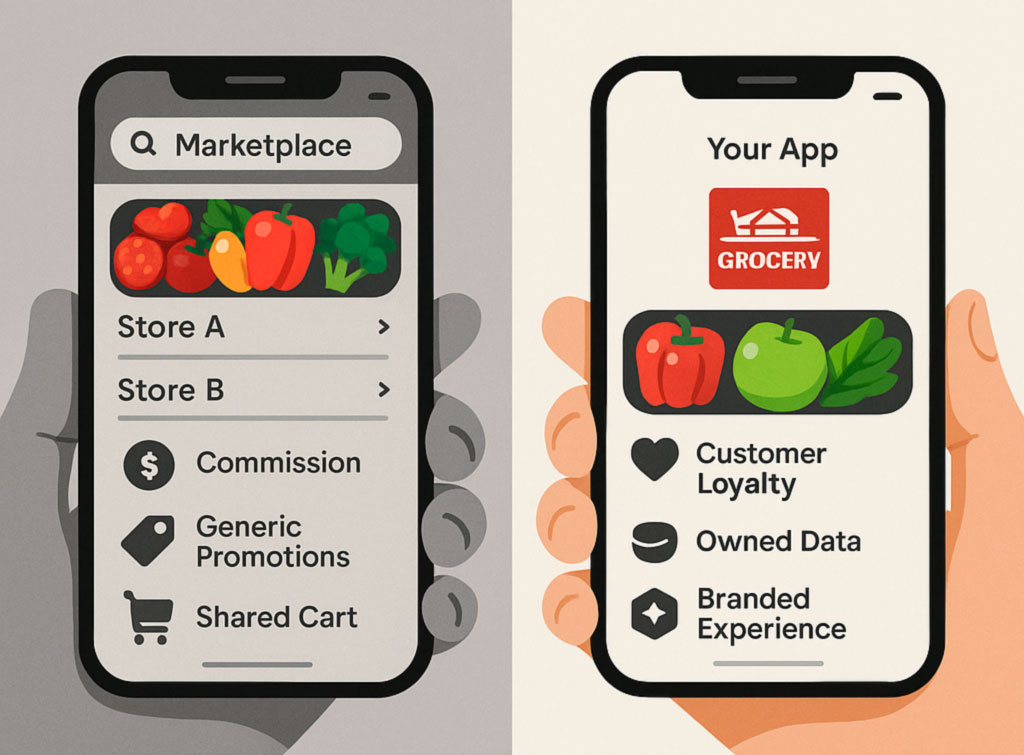
Build a Grocery Store That Converts, and Actually Belongs to You
Most grocery retailers rely on third-party apps to go digital, and in doing so, surrender control over margins, data, and brand loyalty. What looks like convenience is often quiet erosion. This article breaks down why mobile-first Shopify stores are outperforming platforms not just in revenue, but in retention, trust, and long-term growth. If you're still renting shelf space in someone else’s interface, it might be time to reclaim your store. - Artificial Intelligence · Article

Evolution of Physical Retail in the E-Commerce Era: 2015-2025
Discover how physical retail evolved into a strategic capability from 2015 to 2025. From convergence to experiential commerce and ambient intelligence. - Artificial Intelligence · Article

The Digital Slingshot: How Small Businesses Are Quietly Outpacing Giants in 2025
In 2025, small businesses aren’t just catching up, they’re pulling ahead. Discover how SMEs are using smart, agile digital tools to outpace corporate giants through speed, simplicity, and strategic tech adoption.
Questions about working on WooCommerce.
A developer can address a defined technical task. A broader engagement can connect customer research, design, development, and commercial priorities. We help clarify the scope before proposing how to work together.
Yes. The work can focus on a specific buying journey, theme customization, extensions, integrations, or an improvement backlog.
We review the existing setup first. Where practical, we build on what works. If a component needs replacing, we explain the reason and the implications.
We investigate the causes before recommending changes. Hosting, code, images, extensions, and data handling can all affect performance. The scope and expected improvements depend on what we find.
It depends on the agreement. It can include update planning, backups, compatibility checks, testing, and follow-up. We define responsibility for hosting, licenses, and external services.
The quote depends on scope, complexity, integrations, and the condition of your existing setup. Infrastructure, paid tools, and payment processing are separate budget considerations.
We assess the systems, available APIs, required data, and handoffs. We define the integration and responsibilities before committing to implementation.
Ownership depends on your contracts, hosting, licenses, and the scope of custom development. We define access, documentation, handover, and responsibilities explicitly.
WooCommerce is often a better choice for deep customization, advanced SEO and content architecture, complex B2B workflows, custom checkout and payment integrations, and control over code and hosting. Shopify is often preferable for a faster launch, integrated hosting, and lower infrastructure management. The decision depends on your business model, operating resources, and total cost.
WordPress and WooCommerce offer greater flexibility for advanced SEO, including custom content structures, URL architecture, technical templates, structured data, and editorial experiences. Shopify supports common SEO requirements within more predefined platform constraints. Better rankings are not automatic.
WooCommerce provides a Payment Gateway API for building integrations with compatible payment processors. Feasibility depends on the provider's APIs, merchant eligibility, security requirements, and regulations.
Potentially, through compatible plugins, intermediaries, or custom APIs. Some are networks, wallets, or financing methods rather than payment gateways. Availability and integration paths vary by country and provider.
We can assess existing installations on these and other hosts, review caching, database performance, configuration, extensions, security, and resource limits. Migration is recommended only when the infrastructure is a demonstrated constraint.
Premium managed hosting can be worthwhile when specialized infrastructure, support, backups, staging, and operational tools justify the investment. We assess traffic, performance requirements, integrations, and the cost of operating the store.
Yes, when hosting, code, database, integrations, and maintenance are designed for the workload. Capacity should be assessed against traffic, catalog complexity, and transaction volumes.
WooCommerce can be operated securely with appropriate hosting, updates, access controls, backups, monitoring, and maintained extensions. Greater control also brings more operational responsibility.
Their extensible architecture supports custom APIs, automation, and integration with AI-powered tools. Available capabilities depend on the technologies selected, data access, permissions, and development required.
WooCommerce gives developers extensive control over checkout logic, custom fields, approvals, and payment gateway integrations. For legally permitted regulated products or services, that flexibility can help accommodate specialized requirements. Feasibility depends on local law, hosting policies, merchant approval, payment-provider APIs, and compliance obligations. Shopify platform rules, Shopify Payments eligibility, Shop channel rules, and other Shopify services must be evaluated separately rather than treated as one blanket restriction.
What should your WooCommerce store do better?
Share your store, current challenges, and next priority.
We can discuss the scope for a focused improvement, a redesign, or ongoing work.
Schedule a meetingPrefer to write first? Tell us about your project.