
UX Audit Services · Ecommerce
UX audit: understand what gets in your customers’ way.
We review key journeys, interface clarity, and mobile usability to identify friction in your ecommerce experience.
Get documented findings, severity ratings, and recommendations to guide the next decisions.
Where does the experience become difficult?
An audit helps turn concerns into documented issues and questions to investigate.
Customers struggle to decide
Review navigation, product information, options, and policies that support a buying decision.
A journey is hard to complete
Inspect transitions, forms, feedback, and error recovery across the agreed tasks.
Mobile needs closer attention
Review content, controls, overlays, and interaction states on the devices that matter.
A defined scope for your website UX audit.
We agree on tasks, pages, devices, and access before the review begins.
Key journeys
Walk through agreed tasks, from finding and evaluating a product to progressing through cart and checkout.
Heuristic evaluation
Review the interface against established usability principles, documenting the issue and its context.
Mobile usability
Inspect responsive layouts, navigation, forms, controls, and important interaction states.
Available evidence
Review relevant analytics, customer feedback, and existing research to inform the findings.
See the issue, the evidence, and the next step.
Each finding identifies the task and interface state, explains the usability concern, and proposes a next step. Severity helps assess the issue; implementation priorities also consider reach, effort, and dependencies.
Location and task
Where the issue occurs and what the customer is trying to do.
Evidence
The annotated interface, available observations, and limits of the finding.
Severity
The assessed impact on usability, with the reasoning behind the rating.
Recommendation
A proposed change or a question that needs further validation.
Next decision
How the team can investigate, plan, or assess the recommendation.
From business context to a clear audit handoff.
Commercial context and sales measurement inform every stage.
Discover
Understand the offer, customers, tasks, business concerns, and available evidence.
Define
Agree on the review scope, devices, access, evaluation criteria, and deliverables.
Develop
Inspect the journeys, document findings, and prepare recommendations and validation questions.
Deliver
Walk through the findings with your team and agree on the next priorities.
An audit your team can work with.
Research, design, implementation, or CRO can follow as an agreed next scope.
Scope and summary
The reviewed tasks, pages, devices, limitations, and main findings.
Annotated findings
Screenshots and issue records with context, evidence, and severity.
Prioritized recommendations
A proposed backlog with rationale, dependencies, and questions to validate.
Findings walkthrough
A discussion of the findings and the next decisions with your team.
From the Blog
Further reading.
Articles from our blog on the topics this page covers.
- Analytics Tools · Article
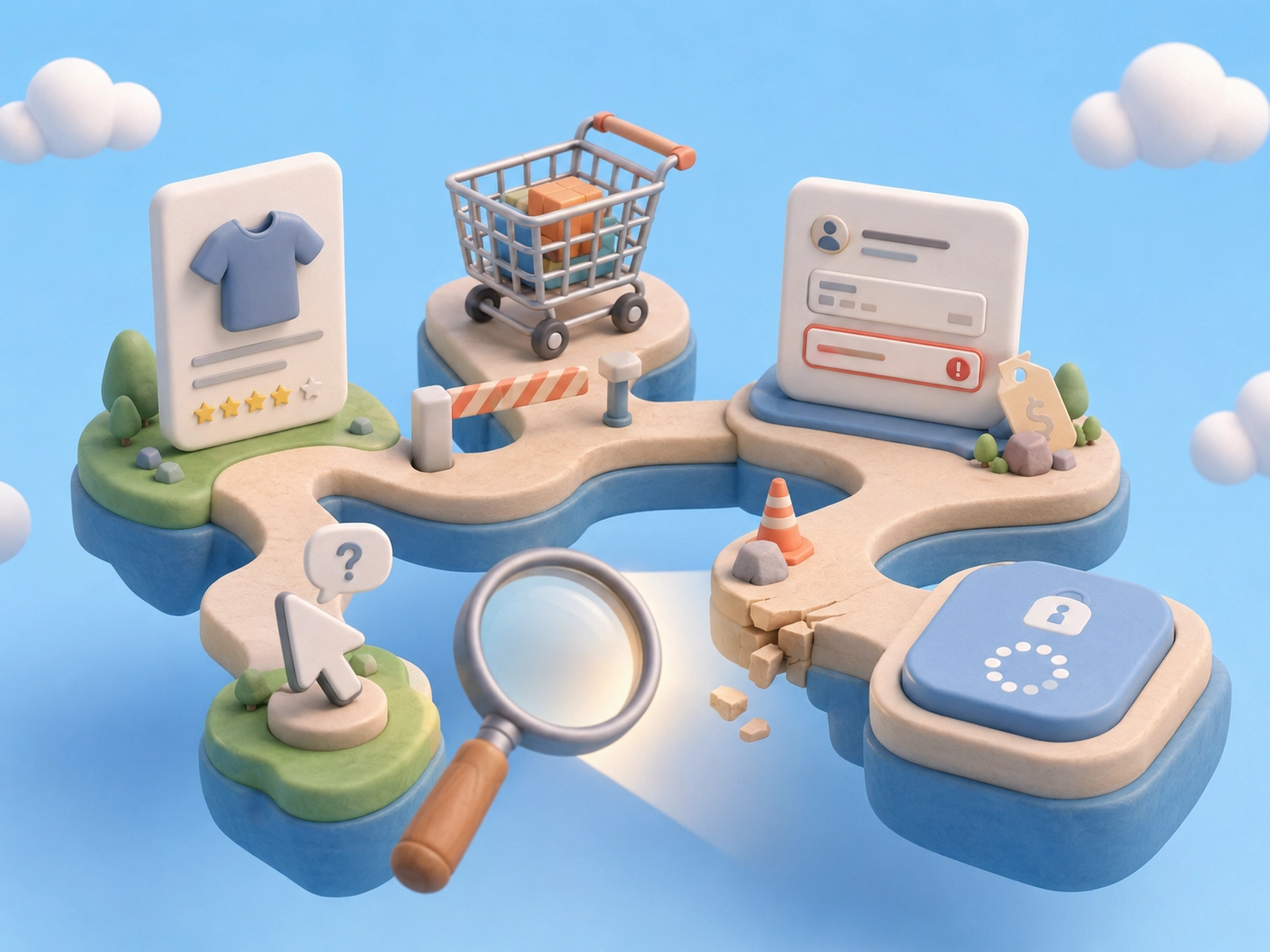
Ecommerce Friction: How to Find the UX Issues That Slow Down Sales
More traffic works better when your store helps people buy. Ecommerce friction appears when customers hesitate, repeat clicks, get confused, lose trust, or leave before checkout. This article shows how to detect those friction points with simple usability analysis, data, and customer behavior before guessing what to redesign. - Customer Experience · Article

Understanding What Your Customer Needs Improves Your Store
You know your business. But your customers see your store differently. Learn how simple user research helps you improve your store with real customer signals, not guesses. - Customer Experience · Article

Turn Your Store Menu Into Your Best Salesperson
Your store menu should not be just a list of products. It should help customers understand what they are looking for, what options they have, and which product fits best. This article explains how navigation, category pages, filters, and product pages can guide better buying decisions. - Business Models and Growth · Article

From Launch to Scale: My UX-Led Reading of The Cold Start Problem
A UX-led reading of The Cold Start Problem: how startups move from launch to defensibility through research, design, and growth. - Artificial Intelligence · Article

AI hype will drown companies in noise. But real creatives will rise
AI isn’t replacing creativity, it’s replacing tasks. The real danger isn’t automation. It’s believing generative content is the same as original thinking. This article breaks the myth and defends the human insight behind real growth. - Customer Experience · Article
UX Is Emotion: The 7 Habits of Stores That Convert in 2025 – 2026
This article unpacks the 7 behavioral habits behind the most successful e-commerce stores of 2025. Learn how to design for emotional flow, reinforce trust at every step, and turn your store into a seamless engine of momentum, clarity, and conversion.
Planning a UX audit.
We agree on key tasks, pages, devices, and evidence sources. The audit documents usability findings, severity, and recommendations within that scope.
No. Expert inspection evaluates the interface and tasks. Usability testing observes participants using the experience and is scoped separately.
Yes. We define the buying journeys, devices, and interface areas to review, including any access or platform constraints.
Existing data helps inform the review, but an expert audit can begin without it. We document assumptions and identify where further evidence is needed.
The audit delivers findings and recommendations. Design, development, research, or CRO can be agreed as a follow-up scope.
We quote the work after agreeing on tasks, pages, devices, access, and deliverables. Participant research or specialized evaluation is scoped separately.
No. It identifies usability concerns and guides decisions. The effect of changes must be evaluated alongside the offer, demand, and other business conditions.
Related services.
Which journey should we investigate first?
Share your website, the tasks that matter, and the concerns your team wants to understand.
We can discuss a focused UX audit and its deliverables.
Schedule a meetingPrefer to write first? Tell us about your project.