
Customer Journey Mapping · Ecommerce Experience
Customer journey mapping for a connected ecommerce experience.
Understand how customers move between discovery, buying, and life after purchase.
We connect available evidence into a clear journey map, surface gaps, and identify the next decisions for your team.
Where does the experience break between teams and channels?
Marketing, ecommerce, support, and operations often see different parts of the same experience. Customer journey mapping brings those perspectives together around what customers are trying to accomplish.
Promises and delivery
Compare what customers are told with what they encounter when choosing, ordering, and receiving a product.
Channel transitions
Examine where people need to repeat information, restart a task, or seek help when moving between touchpoints.
Competing priorities
Give teams a shared view of the evidence, open questions, and dependencies behind the next decision.
Define the journey before choosing the diagram.
A useful map starts with a customer, a scenario, and a decision. Its structure follows the experience your team needs to understand.
Customer and scenario
Define whose experience is being mapped, what they are trying to do, and where the journey begins and ends.
Actions and touchpoints
Connect customer actions with the channels, interactions, and transitions relevant to the scenario.
Needs and barriers
Document what the evidence reveals about customer needs, unanswered questions, and obstacles.
Team dependencies
Identify the teams and external dependencies connected to a gap, and what needs to be clarified before action.
Priorities and next steps
Turn the map into a focused set of opportunities, questions, and proposed next actions.
Make the evidence behind the map visible.
We distinguish documented customer evidence from team assumptions and missing information. Interviews, existing research, support records, and behavioral data can contribute different parts of the picture.
What is documented
Connect a finding to its source, context, and limits.
What the team believes
Make internal assumptions explicit so they can be investigated.
What is still unknown
Identify the research or data needed before making a stronger claim.
Working sessions
A focused working session helps teams align the scenario, review evidence, and discuss ownership. It does not replace customer research.
Move from a shared question to a usable set of priorities.
Commercial measurement continues across the work. Changes to the experience need their own implementation and evaluation plan.
Discover
Review the business question, customer scenario, and available evidence. Identify what the team knows and what is missing.
Define
Agree on the journey boundaries, relevant touchpoints, and the gaps that deserve further attention.
Develop
Build and review the map with the relevant teams. Separate findings from assumptions and compare possible next actions.
Deliver
Hand over the map, evidence references, and priorities with proposed ownership, dependencies, and a plan for review.
A journey map your team can use after the workshop.
The agreed scope determines whether the work includes new customer research, a proposed future journey, or an operational service blueprint.
Defined journey
A documented audience, scenario, scope, and set of relevant touchpoints.
Evidence and open questions
Source references, assumptions, and gaps that explain how to read the map.
Opportunity priorities
A focused set of issues and opportunities, with the reasoning behind their priority.
Ownership and dependencies
Proposed team ownership, dependencies, and decisions needed to move forward.
Review plan
An agreed way to revisit the map as evidence, channels, and customer expectations change.
From the Blog
Further reading.
Articles from our blog on the topics this page covers.
- Analytics Tools · Article
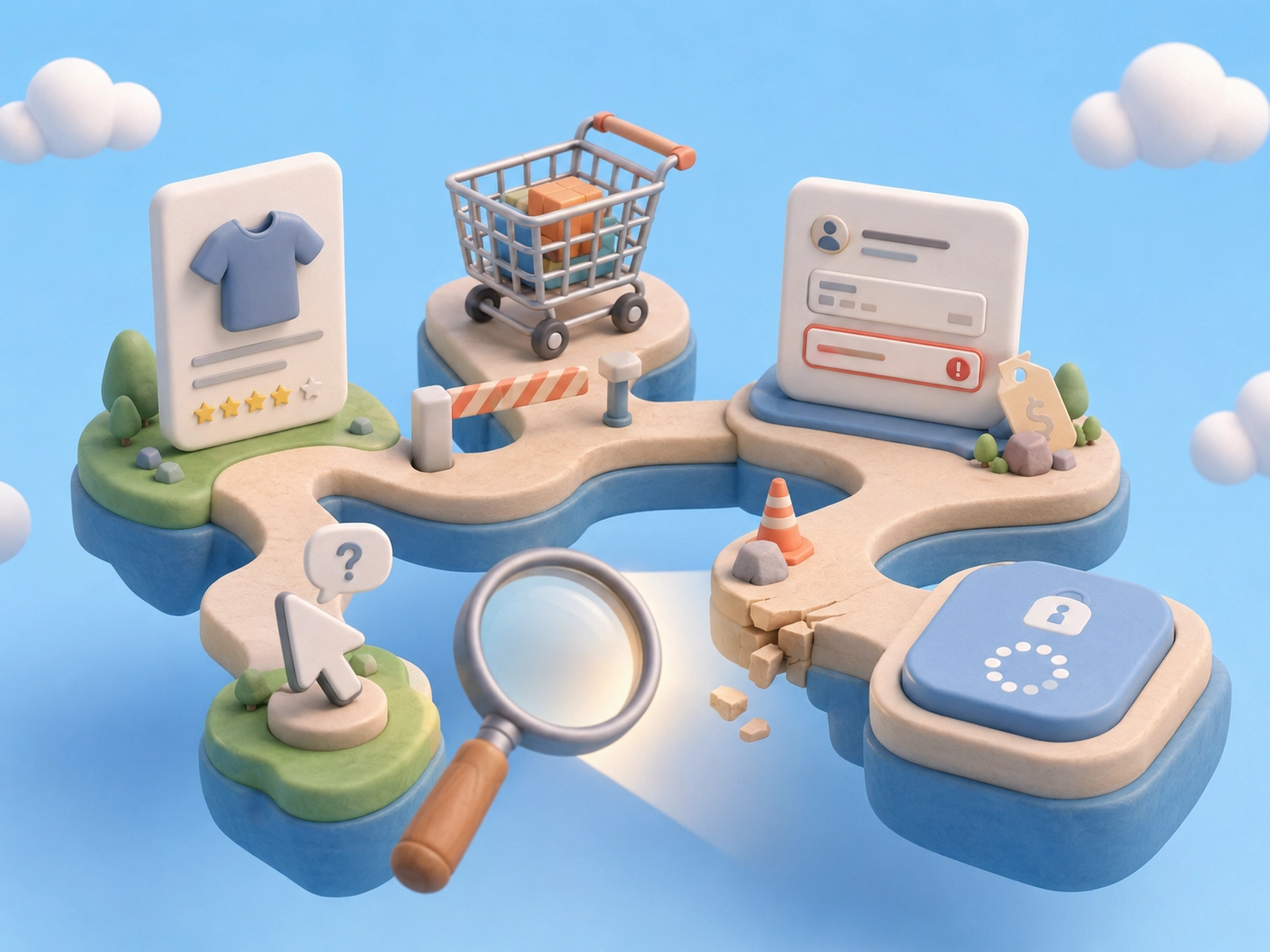
Ecommerce Friction: How to Find the UX Issues That Slow Down Sales
More traffic works better when your store helps people buy. Ecommerce friction appears when customers hesitate, repeat clicks, get confused, lose trust, or leave before checkout. This article shows how to detect those friction points with simple usability analysis, data, and customer behavior before guessing what to redesign. - Customer Experience · Article

Understanding What Your Customer Needs Improves Your Store
You know your business. But your customers see your store differently. Learn how simple user research helps you improve your store with real customer signals, not guesses. - Customer Experience · Article

Turn Your Store Menu Into Your Best Salesperson
Your store menu should not be just a list of products. It should help customers understand what they are looking for, what options they have, and which product fits best. This article explains how navigation, category pages, filters, and product pages can guide better buying decisions. - Business Models and Growth · Article

From Launch to Scale: My UX-Led Reading of The Cold Start Problem
A UX-led reading of The Cold Start Problem: how startups move from launch to defensibility through research, design, and growth. - Artificial Intelligence · Article

AI hype will drown companies in noise. But real creatives will rise
AI isn’t replacing creativity, it’s replacing tasks. The real danger isn’t automation. It’s believing generative content is the same as original thinking. This article breaks the myth and defends the human insight behind real growth. - Customer Experience · Article

UX Is Emotion: The 7 Habits of Stores That Convert in 2025 – 2026
This article unpacks the 7 behavioral habits behind the most successful e-commerce stores of 2025. Learn how to design for emotional flow, reinforce trust at every step, and turn your store into a seamless engine of momentum, clarity, and conversion.
Customer journey mapping questions.
The scope starts with a customer scenario and a decision. The core work connects relevant touchpoints, available evidence, gaps, and priorities. We agree on the boundaries and deliverables before starting.
A funnel summarizes progression toward an outcome. A journey map examines the customer’s actions and experience across a scenario, including transitions, pauses, and paths that may not follow a straight line.
That depends on the evidence available and the decisions you need to make. Existing research may support the map. Where customer evidence is missing, we identify the research needed rather than presenting assumptions as findings.
Yes. A working session can define the scenario, gather team knowledge, and surface assumptions. A map built from internal knowledge remains provisional until the relevant customer evidence is available.
A journey map focuses on the customer’s experience. A service blueprint adds the operational activities and dependencies that support it. Blueprinting is included only when that work is part of the agreed scope.
Available behavioral data can help examine actions and transitions. Its coverage and limitations matter. New tracking, dashboards, and ongoing analytics require a separate agreed scope.
Cost depends on the scenarios, evidence, research needs, channels, and deliverables. We define a focused scope before preparing a proposal.
The map helps the team identify and prioritize opportunities. Commercial outcomes depend on what changes are implemented and how those changes are evaluated.
Related services.
What needs to happen next in the journey?
Share the customer scenario and the decision your team is trying to make.
We can discuss the evidence, scope, and priorities a journey map should clarify.
Schedule a meetingPrefer to write first? Tell us about your project.